
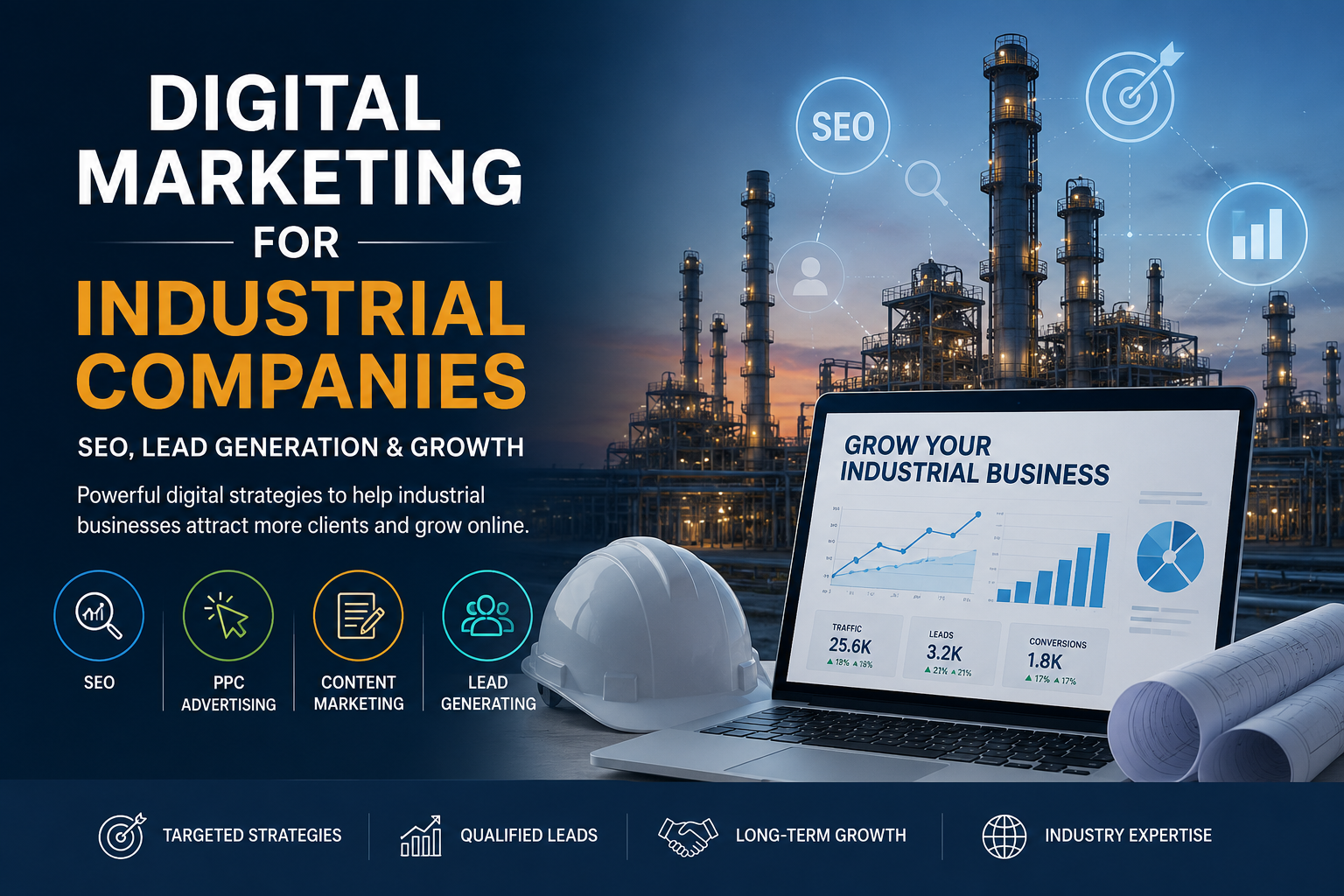
Digital Marketing for Industrial Companies
The Industrial Buyer Has Already Done the Research Before You Call
If your sales team is still relying on cold calls as the primary way new business gets started, here is the number that should prompt a rethink: B2B buyers now complete over two-thirds of their purchasing journey independently before they make first contact with a supplier. They’ve run the searches, read the technical specifications, compared your products against alternatives, checked your case studies, and formed a view — all before your phone ever rings.
Digital Marketing for Industrial Companies — manufacturers, equipment suppliers, engineering firms, distributors, chemical producers, metalworking specialists — this shift is more pronounced than in most sectors. Industrial buyers are technical people. Engineers, procurement managers, operations directors. They do not respond to general marketing messages. They research specifically and deeply, and when they finally reach out to a supplier, it’s because that supplier’s digital presence gave them a reason to.
Gartner’s Future of Sales research predicts that 80% of all B2B sales interactions between suppliers and buyers will occur in digital channels by 2025. That’s not a future state — it’s now. The Digital Marketing for Industrial Companies that understood this early have built lead-generation machines that run around the clock. The ones that haven’t are watching their most capable competitors take enquiries they should have been first in line for.
This guide covers what digital marketing actually looks like Digital Marketing for Industrial Companies — not generic B2B advice repainted in a different colour, but the specific strategies, channels, and content approaches that work when your customer is an engineer sourcing a hydraulic component or a procurement manager evaluating a new contract manufacturer.
The shift in industrial buying is already here
65% of industrial B2B buyers made at least one online purchase in 2025 — up from 45% in 2018. 58% of those purchases now happen outside traditional distributor relationships. Industrial buyers expect the same digital fluency from suppliers that they get as consumers. If your website can’t answer their technical questions, your competitor’s will.
Why Industrial Companies Have Been Slow to Adopt Digital Marketing
It’s worth being honest about this, because the reasons are real even if the outcome is costly. Industrial companies operate in markets where relationships have traditionally driven revenue. A long-standing contract with a tier-one OEM, a distributor network built over 30 years, a sales team that knows every plant manager on its patch — these are competitive advantages that felt more durable than any website or SEO programme.
Three things have eroded that assumption faster than most industrial businesses expected.
First, the people making procurement decisions have changed. Millennials now make up more than half of B2B decision-makers. This generation does not call suppliers first — they search, compare, and form opinions online, then contact the short-listed candidates. The plant manager who took your sales rep to lunch every quarter is retiring. The engineer who replaces them learned to buy on Amazon and expects the same digital fluency from industrial suppliers.
Second, the buying committee has expanded. In 68% of B2B purchasing projects researched over recent years, the number of stakeholders involved increased by two to three times compared to 2018. Engineers evaluate technical specifications. Procurement checks pricing and lead times. Finance models total cost of ownership. Operations assesses integration requirements. Digital marketing reaches all of them simultaneously, with content tailored to each role. A sales rep can only be in one meeting at a time.
Third, companies that adopted digital early are generating compounding advantages. Manufacturers running digital strategies are seeing growth rates two to three times higher than those using conventional methods alone. That gap widens every year the digital-first businesses compound their content libraries, their search rankings, and their email subscriber bases.
The bottom line The industrial companies most at risk aren’t the ones with no digital marketing — it’s the ones with digital marketing that doesn’t match how their buyers actually research. A website that reads like a brochure, a LinkedIn page with no content, a blog last updated in 2021 — these don’t just fail to generate leads, they actively signal to technical buyers that you’re not the kind of company that stays current.
Why Choose XCore Agency for Digital Growth?
At XCore Agency, we help businesses grow online through powerful SEO, professional web development, social media marketing, branding, and digital advertising solutions. Our goal is simple: to increase your visibility, generate quality leads, and turn visitors into loyal customers. With a results-driven approach, customized strategies, and a commitment to excellence, XCore Agency empowers startups, small businesses, and established brands to achieve sustainable growth in today’s competitive digital landscape. Whether you need higher Google rankings, a modern website, or a complete digital marketing strategy, XCore Agency is your trusted partner for success
Understanding the Industrial Buying Process
Industrial purchases are not impulse decisions. A capital equipment purchase can involve a twelve-month evaluation cycle, ten internal stakeholders, three rounds of technical review, and a formal RFP process. Marketing that treats this like a consumer purchase — ‘click here to buy’ — fails to engage at the points in the process where influence is actually possible.
The six stages of the modern industrial buying journey
Gartner maps the B2B buyer journey across six non-linear stages: problem identification, solution exploration, requirements building, supplier selection, validation, and consensus creation. The critical insight is that they’re non-linear — buyers loop back, revisit earlier stages when new information arrives, and often run multiple stages simultaneously across different members of the buying team.
Who you’re actually marketing to
Industrial purchases typically involve multiple people with very different information needs. Your digital marketing has to work for all of them, which means creating different types of content for different roles.
- Engineers — they want technical depth. Specifications, tolerances, materials, compatibility data, application examples, and CAD files. They distrust marketing language and trust data.
- Procurement managers — they want pricing transparency, lead times, minimum order quantities, quality certifications, and supplier reliability evidence. 74% of B2B buyers expect clear and detailed pricing upfront.
- Operations and maintenance — they want ease of integration, maintenance requirements, spare parts availability, and total cost of ownership data.
- Finance and C-suite — they want ROI justification, risk reduction framing, and evidence that you’ve delivered results for comparable companies.
The mistake most industrial companies make is producing only one type of content — usually either the technical detail their engineers love or the high-level capability statements their sales team are comfortable with — and wondering why conversion rates are low. Both are necessary. Neither is sufficient alone.
The bottom line Industrial digital marketing isn’t about interrupting buyers with messages they didn’t ask for. It’s about being present — with the right content, at the right depth — when buyers are already looking. Think of your website as a technical library your prospects use to do their job, not a brochure they flip through to be impressed.
Your Website — The Foundation Everything Else Depends On
Before any discussion of SEO, LinkedIn, or email marketing makes sense, the website needs to be right. For industrial companies, this is often where the most significant gap exists between potential and performance. A website that loads slowly, is hard to navigate on mobile, or fails to answer technical questions clearly will undermine every other marketing investment you make.
What industrial buyers actually need from a website
Industrial buyers use your website differently to consumer buyers. They’re not browsing — they’re researching. They arrive with specific questions: does this product handle this temperature range? What are the lead times for custom orders? Do you have ISO 9001 certification? What surface finishes are available? If your website can’t answer those questions quickly and clearly, they go elsewhere. Probably to a competitor who can.
- Product pages with genuine technical depth — specifications, materials, dimensions, tolerances, compatibility information, and application guidance. Not marketing language about ‘innovative solutions.’
- Downloadable resources — data sheets, technical drawings, CAD files, installation guides, and compliance certificates. These are the assets that keep engineers on your site and coming back.
- Clear capability statements — what industries you serve, what volumes you handle, what certifications you hold, and what your manufacturing or supply capabilities actually are.
- Case studies with real outcomes — not ‘we helped a leading manufacturer improve efficiency’ but ‘we reduced scrap rates by 18% for a Tier 2 automotive supplier in Birmingham.’
- Transparent process and lead time information — industrial buyers are managing project timelines. Vague ‘contact us for lead times’ responses cost you enquiries.
- Multiple contact routes — phone, email, contact form, and live chat where feasible. Different buyers have different preferences. Don’t force everyone through the same channel.
Technical performance — the non-negotiable basics
Industrial buyers often access supplier websites on plant floor tablets or in field settings with variable connectivity. A site that takes eight seconds to load loses the enquiry. Google’s Core Web Vitals — loading speed, visual stability, interactivity — are both a user experience requirement and a search ranking factor. If your site scores poorly on these metrics, it’s costing you both visitors and rankings.
Mobile optimisation is non-negotiable in 2025. Even in industrial markets where desktop research is common, mobile accounts for a significant share of initial searches and often the decisive moment when a buyer checks your website from a site visit or trade show.
Google PageSpeed Insights — free performance testing: Google PageSpeed Insights
Google Search Console — free technical health monitoring: Google Search Console
The single most common industrial website failure
Industrial companies typically have comprehensive product ranges — sometimes thousands of SKUs — and the instinct is to list them all with minimal description to save time. This is the opposite of what works. Search engines can’t rank thin product pages, and buyers can’t make decisions from them. Prioritise depth on your highest-margin or highest-volume product families and build outward from there.
SEO for Industrial Companies — Getting Found When It Matters
Industrial SEO is different from consumer SEO in one important way: the search volumes are low and the intent is extremely high. Nobody searches ‘precision turned components aluminium 5-axis’ out of curiosity. When someone types that into Google, they have a specific requirement and they’re actively sourcing. Getting to the top of that search is worth far more than ranking for a broad term with ten times the volume.
Industrial keyword strategy — specificity over volume
Industrial buyers search the way they think — technically. They use part numbers, material grades, process names, industry standards, and application-specific terminology. Your keyword strategy should reflect how your customers actually describe what they’re looking for, not how your marketing team talks about your products.
Start by interviewing your sales team and your existing customers. Ask them: what did you search for when you were looking for a supplier like us? What search terms do you use when you’re specifying products in our category? Those answers are your keyword strategy. They’re also almost certainly terms your competitors haven’t bothered to optimise for, because they’re too focused on broad category terms with high competition.
Content structure for industrial SEO
The most effective SEO structure for industrial companies is a topic cluster model: a comprehensive pillar page covering a broad product category or application area, supported by a network of deeper pages covering specific products, specifications, applications, and technical questions. Each supporting page links back to the pillar, and the pillar links out to the supporting pages. This structure tells search engines that your site is a genuine authority on the topic, not a collection of thin unrelated pages.
Example: a hydraulic components manufacturer might build a pillar page on ‘Industrial Hydraulic Cylinders’ supported by individual pages on custom hydraulic cylinders, hydraulic cylinders for offshore applications, hydraulic cylinder repair and maintenance, specifying hydraulic cylinders for high-temperature environments, and a comparison guide between different cylinder types. Each page serves a different stage of the buyer journey and captures different search queries.
Technical SEO for industrial sites
Industrial websites often have specific technical challenges that general web agencies don’t anticipate. Large product catalogues with thousands of similar product pages create duplicate content problems. PDF data sheets that aren’t text-indexed are invisible to search engines. Poorly structured navigation makes it hard for Google to understand which pages are most important. Legacy systems that prevent proper URL structures.
- Ensure product pages have unique, substantive descriptions — not just copied manufacturer specs
- Make data sheets and technical documents text-searchable where possible, not just scanned image PDFs
- Implement structured data markup for products — this enables rich results in search including specifications and ratings
- Create clear site architecture that reflects your product hierarchy and makes crawling efficient
- Build canonical tags correctly across similar product variants to avoid cannibalisation
Semrush — keyword research and site audit for industrial SEO: Semrush
Ahrefs — competitive keyword gap analysis: Ahrefs
Screaming Frog — site crawl for technical SEO issues: Screaming Frog
Frequently Asked Questions
The Bottom Line
Industrial buyers have changed. They research independently, they complete most of the buying journey before contacting you, and they expect the same digital fluency from industrial suppliers that they get from every other category of business they buy from. The companies that have understood this and built their digital presence accordingly are now generating consistent enquiry pipelines that their competitors are struggling to replicate.
The good news for industrial companies starting or improving their digital marketing is that the barriers are lower than they might appear. Industrial SEO operates in relatively low-competition keyword environments where the right content beats spending on advertising. LinkedIn is genuinely accessible for companies whose technical staff are willing to share their expertise. Email nurturing doesn’t require expensive technology — it requires useful content and a maintained list.
What it does require is patience with long-term programmes, willingness to treat marketing as an investment rather than a cost, and the discipline to measure what connects to revenue rather than what flatters the marketing team’s effort. The industrial companies that get this right typically see their first significant traction in months six to twelve, and the compound effect building strongly from year two onwards.
Start with the website — make it technically useful, not just visually polished. Build the content library around what your buyers actually search for. Get one or two engineers or technical directors posting on LinkedIn with genuine consistency. Build the email list and nurture it with content that earns the subscription. Then add paid channels for acceleration once the foundations are in place.
This guide draws on publicly available 2025 research and industry data. Marketing results vary by sector, competitive landscape, and execution quality. The strategies outlined here reflect what consistently works across industrial B2B marketing — not guaranteed outcomes.
One point that stands out is how much of the industrial buying process now happens before a supplier ever gets a chance to speak with a prospect. For technical buyers, detailed specifications, case studies, and clear answers to common engineering questions can be just as important as ranking well in search results. Companies that align their digital content with the questions buyers are already researching are likely to generate more qualified inquiries.